
From Marketing & Sales Books Magazine, Q3, 2015
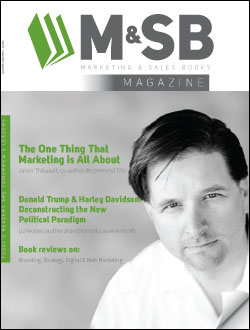
View the article (in pdf format)
From Expert Marketer Magazine, EMM 5 - Q1, 2014
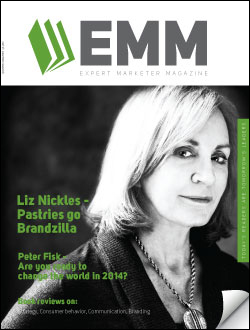
View the article (in pdf format)

From
The Wall Street Journal
Ben Zimmer
Nov. 22, 2013
In the remembrances of John F. Kennedy's presidency this week as the 50th anniversary of his assassination passes, one word continues to resonate above all: Camelot.
The name of King Arthur's mythical court city has its roots in medieval romantic literature, but thanks to skillful media manipulation by Jacqueline Kennedy after her husband's death, "Camelot" remains a potent mythmaking metaphor for the Kennedy administration.
The name first appeared as "Camaalot" in a 12th-century French poem about Lancelot written by Chrétien de Troyes, but etymologists are unsure if that was intended to refer to a real-life British location, such as Colchester (known in Latin as Camuladonum) or Cadbury (situated near the River Cam).
Click here to view the full article from the Wall Street Journal
From
USA WEEKEND, October 25, 1998
http://159.54.226.237/98_issues/981025/981025milennium.html
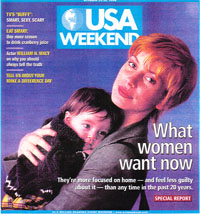
From The New York Times Magazine, August 22, 1999.
On
the Brink:
A POLL According to the Gen Y2K Report, a recent survey of 2,000 young
men and women: Of those ages 16 to 19,
41 percent say there
are people they want to get even with.
43 percent say
they sometimes are pushed too far and feel they will explode.
58 percent of
this explosive group agree they would use a gun “if I had to.”
53 percent of this group watch TV movies, compared with
34 percent of those who do not feel they will explode.
The study’s authors,
Liz Nickles and Laurie Ashcraft, report that controlling parents may be
to blame for kids’ volatility. “Most people assume that teens
who exhibit . . . violent tendencies are the result of hands-off parenting,”
Nickles says. “In the population we studied, the opposite is the
case.” Says Ashcraft, “Overscheduled, pressured children are
an emotional powder keg.”
From American Demographics, March 1999
|
Status
Unconscious
|
||||||||||||||||||||||||
From American Demographics, August 1999
|
Don’t
Call Me Slacker, Dude
|
||||||||||||||||||||||||||||||||||||||||
Fall, 2001
Liz
Nickles’ new book
The Change Agents:
Understanding the New Workforce and the New Workplace
|
Published by
|
Why the e-revolution has changed the way every company and individual must operate to stay competitive Based
on unique research and interviews, The Change Agents is a
clear-eyed look at what living in a wired world really means to
organizational and individual success. The media has been full of
stories of hot dotcommers over the last few years, but The Change
Agents shows how the rest of us are irrevocably affected by
a paradigm shift as wrenching as the industrial revolution. |
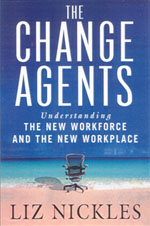
A review of The Change Agents from Library Journal
“A strategic marketing expert and the director of branding, marketing, and advertising at Credit Suisse First Boston, Nickles looks at what living in a wired world means to organizational behavior and individual success, based on thorough and unique research and interviews. The e-revolution has resulted in a paradigm shift as wrenching as the Industrial Revolution and has changed the way every company and individual operates to stay competitive in the marketplace. Decision-making occurs at warp speed, life and work are fused, and serial work careers affect industries built on training employees only once. As Nickles observes, ‘change agents,’ children who grew up with PCs and the Internet, are becoming the ‘new workforce in the new workplace,’ Nickles describes how to understand them and use their talents while avoiding misunderstandings and conflicts. An appendix with “Ten Thoughts for Baby Boomers” and “Ten Thoughts for Baby Moguls” contains valuable suggestions. This work is a worthy addition to any business collection.”
—Susan C. Awe,
Univ. of New Mexico Parish Lib., Albuquerque
Copyright 2001 Cahners
Business Information, Inc.